Por favor, use este identificador para citar o enlazar este ítem:
http://hdl.handle.net/20.500.11765/17634
Exploring the Relationship Between Groundwater Drought and Evapotranspiration With the JULES Land Surface Model in a UK Chalk Catchment
| Título : | Exploring the Relationship Between Groundwater Drought and Evapotranspiration With the JULES Land Surface Model in a UK Chalk Catchment |
| Autor : | Collins, Sarah L.; Martínez de la Torre, Alberto ; Scheidegger, Johanna; Clark, Douglas B.; Hughes, Andrew
 |
| Palabras clave : | Chalk; Drought; Groundwater; Integrated modelling |
| Fecha de publicación : | 2026 |
| Editor: | Hydrological Processes. 2026, 40(4), p. 1-19 |
| Versión del editor: | https://doi.org/10.1002/hyp.70482 |
| Resumen : | Hydrological droughts can last months to years and impact large areas, leading to a multitude of ecological and socio-economicharm. The role of evapotranspiration (ET) in drought is very variable and there is contradicting evidence on the impact of anthro-pogenic warming on groundwater drought in the UK. We integrated a distributed groundwater model into the JULES land sur-face model (JULES-DGW) and simulated a chalk catchment in southern England over the period 1901–2015. The model showeda good match to river flows (Kling–Gupta efficiencies 0.73–0.83) and groundwater levels (r2 = 0.92). We found a general trendof drying over time with small decreases in average moisture in the unsaturated zone and average groundwater levels, causedby increases in annual ET and decreases in recharge as a fraction of precipitation. The model suggests drier conditions in theunsaturated zone in late summer/early autumn in the late 20th–early 21st century have led to a delay in the recharge season. Noincrease in capillary rise was simulated throughout the modelling period and ET was found to decrease in most cases of severedrought, thus acting to limit the fall in groundwater levels.1 | IntroductionHydrological droughts can last months to years and impact largeareas, leading to a multitude of ecological and socio-economicharms, including to water supply, crop production, river navi-gation and electricity production (Van Loon 2015). Climatechange accelerates the terrestrial water cycle, as warming drivesan increase in evapotranspiration (ET), causing more precipi-tation (J. Liu et al. 2013; Scheff and Frierson 2014). Increasesin ET have caused an intensification of the dry season acrosslarge parts of the globe (Padrón et al. 2020), bringing more fre-quent and intense ecological and agricultural droughts since the1950s, although there is little agreement regarding changes innorthern Europe (IPCC 2023). In the near future, analyses indi-cate reducing low flows and increasing duration and severity ofhydrological drought for much of the globe (e.g., Hari et al. 2020;C. Zhao et al. 2020; Spinoni et al. 2021; Gu et al. 2023).Groundwater is the Earth's largest liquid store of freshwater. Itplays a fundamental role in public water supply, irrigation andterrestrial ecosystems (Gleeson et al. 2012), sustaining base-flow to rivers, lakes and wetlands in periods of low rainfall.Groundwater comprises ~25% of all freshwater withdrawals(UN 2022) with an estimated 2.5 billion people solely dependenton its use (UNESCO 2015). Within the world's cities, groundwa-ter use is intensifying, with just under 50% of the global urbanpopulation dependent on groundwater (Foster et al. 2020).Groundwater systems are inherently more resilient to climatevariability, storing water from periods of surplus and, largely,protected from the evaporative losses suffered by reservoirs.This is an open access article under the terms of the Creative Commons Attribution License, which permits use, distribution and reproduction in any medium,provided the original work is properly cited.© 2026 British Geological Survey © UKRI. Hydrological Processes published by John Wiley & Sons Ltd. |
| Patrocinador: | This work was supported by Natural Environment Research Council(NE/S017380/1). |
| URI : | http://hdl.handle.net/20.500.11765/17634 |
| ISSN : | 0885-6087 0885-6087 |
| Colecciones: | Artículos científicos 2023-2026 |
Ficheros en este ítem:
| Fichero | Descripción | Tamaño | Formato | ||
|---|---|---|---|---|---|
 | HP_Collins_2026.pdf | 3,12 MB | Adobe PDF | 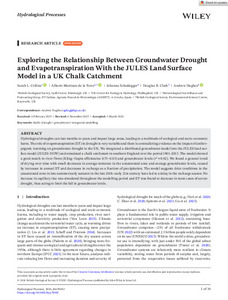 Visualizar/Abrir |


Los ítems de Arcimis están protegidos por una Licencia Creative Commons, salvo que se indique lo contrario.