Por favor, use este identificador para citar o enlazar este ítem:
http://hdl.handle.net/20.500.11765/17965
GNSS Zenith Wet Delay as a Boundary Layer Diagnostic: Regime‐Dependent Turbulence Signatures From LargeEddy Simulation and Observations
Registro completo de metadatos
| Campo DC | Valor | Lengua/Idioma |
|---|---|---|
| dc.contributor.author | Kermarrec, Gaël | es_ES |
| dc.contributor.author | Schrader, Tim | es_ES |
| dc.contributor.author | Calbet, Xavier | es_ES |
| dc.contributor.author | Deng, Zhiguo | es_ES |
| dc.date.accessioned | 2026-06-29T07:17:19Z | - |
| dc.date.available | 2026-06-29T07:17:19Z | - |
| dc.date.issued | 2026 | - |
| dc.identifier.citation | Journal of Geophysical Research: Atmospheres. 2026, 131(12), e2026JD047347 | es_ES |
| dc.identifier.issn | 2169-897X | - |
| dc.identifier.issn | 2169-8996 | - |
| dc.identifier.uri | http://hdl.handle.net/20.500.11765/17965 | - |
| dc.description.abstract | Global Navigation Satellite Systems (GNSS) signals, used routinely for satellite positioning, are slightly delayed as they cross the moist atmosphere. Beyond the slow variations associated with weather forecasting, these delays exhibit rapid fluctuations on timescales of seconds to minutes that are caused by turbulent mixing of water vapor in the lowest kilometers of the atmosphere. We investigate whether two properties of these fluctuations, the total variance and the cutoff frequency of their power spectrum, carry quantitative information on the state of the atmospheric boundary layer. The difficulty is that all the variables of interest, including the wind speed, the humidity variance and the spectral parameters are dominated by a common diurnal cycle which inflates ordinary correlations and makes them physically meaningless. To address this, we develop a coherence analysis that compares the shape of diurnal cycles independently of amplitude and timing offsets. When tested on a high-resolution simulation of a convective boundary layer, the analysis recovers the expected dynamical relations between turbulence intensity, wind speed and the spectral parameters. Run on 3 years of co-located GNSS and wind LiDAR observations from Payerne, Switzerland, the same patterns emerge under summer conditions, while they disappear in winter when the diurnal cycle of turbulence is muted. Spectral parameters can be retrieved from existing GNSS networks with a relative uncertainty below 5% throughout the day, including at night. These results support the use of GNSS as a complementary observing system for boundary-layer dynamics in regions lacking dedicated meteorological instrumentation. | es_ES |
| dc.description.sponsorship | This study is supported by the Deutsche Forschungsgemeinschaft under the project LES2GNSS KE 2453/4-1. | es_ES |
| dc.language.iso | eng | es_ES |
| dc.publisher | American Geophysical Union | es_ES |
| dc.publisher | Wiley | es_ES |
| dc.rights | Licencia CC: Reconocimiento CC BY | es_ES |
| dc.subject | Global Navigation Satellite Systems | es_ES |
| dc.subject | Atmospheric boundary layer | es_ES |
| dc.subject | Water vapor turbulence | es_ES |
| dc.subject | GNSS signal delays | es_ES |
| dc.subject | Boundary-layer dynamics | es_ES |
| dc.title | GNSS Zenith Wet Delay as a Boundary Layer Diagnostic: Regime‐Dependent Turbulence Signatures From LargeEddy Simulation and Observations | es_ES |
| dc.type | info:eu-repo/semantics/article | es_ES |
| dc.relation.publisherversion | https://doi.org/10.1029/2026JD047347 | es_ES |
| dc.rights.accessRights | info:eu-repo/semantics/openAccess | es_ES |
| Colecciones: | Artículos científicos 2023-2026 | |
Ficheros en este ítem:
| Fichero | Descripción | Tamaño | Formato | ||
|---|---|---|---|---|---|
 | JGR_A_Calbet-2026.pdf | 2,36 MB | Adobe PDF | 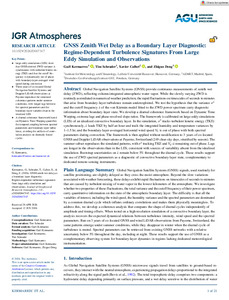 Visualizar/Abrir |


Los ítems de Arcimis están protegidos por una Licencia Creative Commons, salvo que se indique lo contrario.