Por favor, use este identificador para citar o enlazar este ítem:
http://hdl.handle.net/20.500.11765/18161
Capturing the extremes: a quasi-comonotonicity-based algorithm for disaggregating daily to hourly rainfall
Registro completo de metadatos
| Campo DC | Valor | Lengua/Idioma |
|---|---|---|
| dc.contributor.author | Correa, Carlos | es_ES |
| dc.contributor.author | Hernanz Lázaro, Alfonso | es_ES |
| dc.contributor.author | San-Felipe, Iván | es_ES |
| dc.contributor.author | Rodríguez Guisado, Esteban | es_ES |
| dc.date.accessioned | 2026-08-04T08:12:26Z | - |
| dc.date.available | 2026-08-04T08:12:26Z | - |
| dc.date.issued | 2026 | - |
| dc.identifier.citation | Hydrology and Earth System Sciences. 2026, 30(14), p. 4457–4480 | es_ES |
| dc.identifier.issn | 1027-5606 | - |
| dc.identifier.issn | 1607-7938 | - |
| dc.identifier.uri | http://hdl.handle.net/20.500.11765/18161 | - |
| dc.description.abstract | Disaggregating daily precipitation data into hourly time scales is crucial for hydrological modelling, urban drainage design, and extreme rainfall risk assessment. This study presents Q-CODA, a novel Quasi-COmonotonicity-based Disaggregation Algorithm that leverages the quasi-comonotonic relationship between daily precipitation totals and their sub-daily maxima to generate hourly rainfall sequences consistent with observed extremes. The method combines a Fréchet–Hoeffding upper bound copula to constrain sub-daily maxima with a K-nearest neighbours approach and an iterative adjustment algorithm to ensure consistency with daily totals and multiple sub-daily constraints. Q-CODA is evaluated through a 5-fold cross-validation over 91 meteorological stations across Spain (1996–2024) and compared against state-of-the-art methods, including nearest-neighbour resampling, Poisson cluster models, multiplicative cascades, and deep learning approaches. Results show that Q-CODA consistently outperforms state-of-the-art methods in reproducing extremes. Across stations, median values indicate a 1-D Wasserstein distance of 0.015 compared to 0.021–0.073, and a bias in the 99.9th percentile of −2.8 % versus −29 % to +11 %. Temporal structure is also well preserved, with event duration bias of −2.0 % (vs. −22 % to +13 %) and lag-1 autocorrelation bias of −4.4 % (vs. −37 % to −7.8 %). For intensity-duration-frequency curves, Q-CODA attains a median root mean square error of 1.16 mm h−1 for a 100-year return period, improving upon the 1.62–4.60 mm h−1 range of alternative methods. Additional analyses across other climate regimes, including the Pacific Northwest and Florida (United States), show consistently strong performance, indicating stable and reliable behaviour under varying climatic conditions. Furthermore, a semi-parametric regionalised extension enables application at ungauged locations while maintaining competitive accuracy. Overall, Q-CODA provides a consistent and transferable framework for sub-daily rainfall disaggregation with clear advantages for extreme-value representation and hydrometeorological applications. | es_ES |
| dc.language.iso | eng | es_ES |
| dc.publisher | Copernicus Publications | es_ES |
| dc.rights | Licencia CC: Reconocimiento CC BY | es_ES |
| dc.subject | Rainfall | es_ES |
| dc.subject | Extreme precipitation | es_ES |
| dc.subject | Hourly rainfall | es_ES |
| dc.subject | Hydrological modelling | es_ES |
| dc.title | Capturing the extremes: a quasi-comonotonicity-based algorithm for disaggregating daily to hourly rainfall | es_ES |
| dc.type | info:eu-repo/semantics/article | es_ES |
| dc.relation.publisherversion | https://doi.org/10.5194/hess-30-4457-2026 | es_ES |
| dc.rights.accessRights | info:eu-repo/semantics/openAccess | es_ES |
| Colecciones: | Artículos científicos 2023-2026 | |
Ficheros en este ítem:
| Fichero | Descripción | Tamaño | Formato | ||
|---|---|---|---|---|---|
 | HESS_Correa_2026.pdf | 6,47 MB | Adobe PDF | 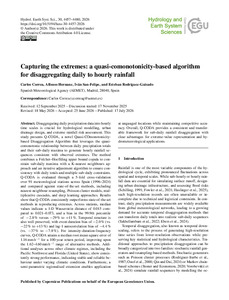 Visualizar/Abrir |


Los ítems de Arcimis están protegidos por una Licencia Creative Commons, salvo que se indique lo contrario.