Por favor, use este identificador para citar o enlazar este ítem:
http://hdl.handle.net/20.500.11765/17331
Evaluation of the uncertainty of the spectral UV irradiance measured by double- and single-monochromator Brewer spectrophotometers
| Título : | Evaluation of the uncertainty of the spectral UV irradiance measured by double- and single-monochromator Brewer spectrophotometers |
| Autor : | González, Carmen; Vilaplana Guerrero, José Manuel; Redondas, Alberto


 ; López Solano, Javier
; San Atanasio, José María
; Kift, Richard; Smedley, Andrew R. D.; Díaz Rodríguez, Ana María
; Babal, Pavel; Jepsen, Nis; Gacitúa, Guisella; Serrano, Antonio
; López Solano, Javier
; San Atanasio, José María
; Kift, Richard; Smedley, Andrew R. D.; Díaz Rodríguez, Ana María
; Babal, Pavel; Jepsen, Nis; Gacitúa, Guisella; Serrano, Antonio |
| Palabras clave : | Solar ultraviolet irradiance; Quality measurements; UV measurements; Brewer spectrophotometers |
| Fecha de publicación : | 2025 |
| Editor: | Copernicus Publications |
| Citación : | Atmospheric Chemistry and Physics. 2025, 25(21), p. 14131–14152 |
| Versión del editor: | https://doi.org/10.5194/acp-25-14131-2025 |
| Resumen : | Brewer instruments are robust, widely used instruments that have been monitoring global solar ultraviolet (UV) irradiance since the 1990s, playing a key role in UV research. Unfortunately, the uncertainties of these measurements are rarely evaluated due to the difficulties involved in characterising the instruments. This evaluation is essential to determine the quality of the measurements as well as their comparability to other datasets. In this study, eight double- and two single-monochromator Brewers are characterised, and the uncertainty of their global UV measurements is estimated using the Monte Carlo method. This methodology is selected because it provides reliable uncertainty estimations and considers the nonlinearity of certain steps in the UV processing algorithm. The combined standard uncertainty depends on the Brewer instrument, varying between 2.5 % and 4 % between 310 and 350 nm. These uncertainties arise primarily from radiometric stability, cosine correction, and the uncertainty of the lamp used during calibration. At shorter wavelengths, the differences between single- and double-monochromator Brewers increase. For example, at 296 nm and a solar zenith angle (SZA) of 40°, the relative uncertainties of single Brewers range between 11 % and 23 %, whereas double Brewers have uncertainties of 3 %–5 %. As the measured wavelength decreases, the correction of stray light (for single Brewers), dark counts, and noise become the dominant sources of uncertainty. These results indicate that the accuracy of fully characterised double Brewers is sufficient for biological studies and trend detection, whereas single Brewers might be limited to wavelengths and SZAs below 305 nm and 70°, respectively. |
| Patrocinador: | This work is part of the PID2023-149390OB-C21 and PID2023-149390OB-C22 R+D+I projects, funded by MICIU/AEI/10.13039/501100011033/ and “ERDF A Way of Doing Europe”. |
| URI : | http://hdl.handle.net/20.500.11765/17331 |
| ISSN : | 1680-7316 1680-7324 |
| Colecciones: | Artículos científicos 2023-2026 |
Ficheros en este ítem:
| Fichero | Descripción | Tamaño | Formato | ||
|---|---|---|---|---|---|
 | ACP_Gonzalez_2025.pdf | 2,06 MB | Adobe PDF | 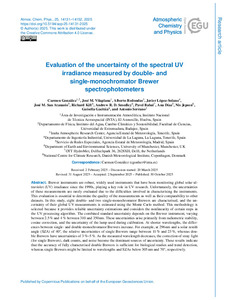 Visualizar/Abrir |


Los ítems de Arcimis están protegidos por una Licencia Creative Commons, salvo que se indique lo contrario.